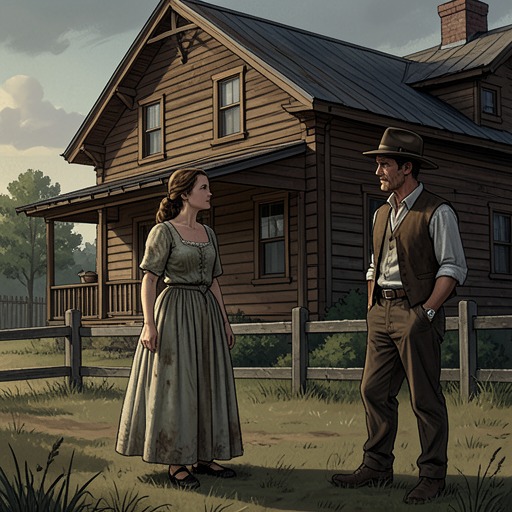
Judge Bailey
The OutlawsJudge Bailey is Roily’s judge and one of the few people Kate Muldoon believes may still be trusted. He understands that the county’s legal institutions cannot reliably oppose Max Landon, yet he uses the authority he retains to help Kate claim her inheritance. His part in arranging and conducting the reading of Red Muldoon’s will turns a compromised legal process into a concrete challenge to Landon’s control of the Diamond M Ranch.
Position and Reputation
Kate identifies Judge Bailey as honest and committed to doing right, but warns that honesty alone cannot make the law effective in a county where it is more an idea than a working protection. She names him as the person she trusts most, while also describing how Landon can frighten people into silence or falsehood. Her account makes Bailey’s standing unusual: he has moral credibility, but the force behind his office is limited.
Kate’s caution is grounded in her changed circumstances. After a year away, she has returned to Roily unsure whether the friends she knew before her father’s death remain dependable. She recalls Adam Jessup, the banker, and Charlie Nathrop, the preacher, as possible allies, but cannot know how much Landon’s influence has altered their behavior. Bailey, by contrast, is the one person she names without hesitation, even as she recognizes that he may not be able to protect her by himself.
The Law Under Landon’s Control
When Del Delaney asks whether Bailey, the sheriff, or anyone else in Roily can protect Kate, Bailey’s response is an account of how power has overtaken formal authority. He says Landon is effectively the law in the county: the sheriff follows the winning side, neighboring counties and the state will not provide help, and the remaining residents lack the strength to oppose Landon by force. Bailey compares that imbalance to a child facing a grown man, questioning what could be achieved by dying in an attempt to resist.
Delaney reads Bailey’s admission as confirmation of what Kate has already told him, but also sees the shame of a judge who is supposed to uphold the law and administer justice. That shame is Delaney’s impression, not a recorded confession by Bailey. The scene nevertheless gives Bailey a difficult kind of integrity: he does not disguise the danger or pretend that legal authority can do what it cannot. His honesty makes him useful to Kate, while his frank recognition of the county’s weakness exposes the limits of his office.
Those limits also shape Bailey’s assessment of Delaney. Delaney explains that he has been accused of rape in Prairie City, though he insists the charge is false. Bailey warns that, if the matter came to trial, it would become one man’s word against another’s, and a stranger’s testimony would carry little weight in the county. The warning joins Delaney’s experience of being pursued under an accusation he denies to Kate’s inability to rely on local law: in both cases, a formal charge or legal role offers little assurance that justice will follow.
Helping Kate Pursue the Inheritance
Bailey responds to Kate’s situation with practical steps rather than assurances of safety. Delaney asks him directly whether he wants to know where Kate is, and Bailey springs up, eager to learn that she is alive and asking where she can be found. Delaney declines to reveal her location, instead raising the harder question of whether Roily can protect her from Landon. Bailey’s immediate concern for Kate is clear, but so is the danger that knowledge of her whereabouts would bring.
Bailey accepts Delaney’s proposal to arrange a reading of the will. When Delaney offers a date, Bailey sets it for three o’clock the day after tomorrow and undertakes to notify Landon. Delaney promises to bring Kate. The agreed time gives their effort a formal destination, but the plan cannot be separated from Bailey’s warning that Landon dominates the county and may be able to intimidate those who might otherwise support her.
Delaney also speaks with Adam Jessup, who is frightened but says that Kate’s position concerns the whole town: people are on her side, yet they do not know how to meet the problem. Jessup’s response echoes Bailey’s distinction between public feeling and effective power. Bailey’s involvement does not make the community suddenly capable of resisting Landon; it gives Kate a legal proceeding in which her claim can be stated and Landon’s position tested.
The Will and Its Consequences
At the reading, Bailey brings out a long envelope and a single sheet of paper, smooths it, and puts on gold-rimmed spectacles before addressing those present. He first explains that Red’s estate consists, apart from personal possessions, of the ranch and savings accounts, together with money in a checking account for Diamond M Ranch operating expenses. Because Landon has had access to that account, Landon knows its balance, while Bailey does not. The detail shows how the foreman’s practical access to the ranch’s finances has given him knowledge Bailey lacks, even before the will is read.
Bailey reads Patrick Muldoon’s will, identifying Patrick as Red Muldoon. It leaves the land, stock, and cash to Red’s daughter, Katharine Ann Muldoon, and expresses Red’s wish that Landon continue as her foreman and eventually become a full partner. If Kate dies, however, the estate is to pass entirely to Landon. The terms distinguish Kate’s inheritance from Landon’s hoped-for future position: he is not named as the present owner, but his continued employment and possible partnership are explicitly contemplated.
After reading the document, Bailey tells Landon that if Kate does not wish to employ him, he must leave the property within twenty-four hours. He adds that, in light of Landon’s recent attempts to murder Kate, she is legally and morally justified in dismissing him as foreman. This is Bailey’s most consequential use of his judicial authority in the supplied events. The will does not simply settle a question of succession; in Bailey’s interpretation, it gives Kate the right to decide whether Landon remains at the ranch.
Landon challenges the will’s authenticity, accusing Bailey of disliking him and claiming that Red would not have made such a will while of sound mind. Bailey remains unruffled and answers that he would have written a different will in different terms, but that Red was strong-minded and had told him what he wanted. Bailey’s response draws a boundary between his own judgment and his duty: he can distinguish the document he would have drafted from the one Red actually made, and he stands by the latter. His role is therefore neither that of an unconstrained rescuer nor a judge able to command the county. He is a witness to Red’s intentions and an official willing to apply them against Landon, despite the fragile reach of law in Roily.